
We recently noticed a wonderful interview with Daniel Grassl about his move to Team Tutberidze on sports.ru. We’ll translate some of this insightful interview here. And hopefully by the end you’ll be smiling just like us! If you notice any incorrect translations or have any comments, let us know over on our Twitter @KikiTheRedPanda

The headline that caught our attention and got us reading was:
“If it wasn’t for Eteri, I would have finished figure skating. Big interview with Daniel Grassl, Tutberidze’s super newcomer”

Italian figure skater Daniel Grassl is having the most difficult season of his career.
His Grand Prix victory was followed by a disappointment at the Italian Championships (he missed the podium for the first time in years), and a dash between continents and coaching groups. And then the transfer of the year in the world figure skating – to Eteri Tutberidze. A step that not everyone would dare to take in the current circumstances.
Grassl still had two difficult competition starts this season: he finished sixth at the European Championship (after winning silver in 2022) and 12th at the World Championship. Sports.ru correspondent Maya Bagryantseva met with Daniel and tried to understand what kind of turbulence brought him to Moscow.
For the past few months, you’ve been written about more than Olympic champions. But let’s rewind a bit and remember how Daniel Grassl became a figure skater in the first place.
* Grassl outside figure skating: adores classical ballet, studies film (but says he’s not too interested in becoming an actor, he prefers behind the camera).
I started skating pretty late, especially by Russian standards, haha. At first I was in the hockey section, but then my mom and I came to see a local figure skating competition – and I really loved it. I was about seven years old, I asked my mom to let me try it – and that was it, gone. At first, I was the only boy in the group, but it didn’t bother me. For a couple of years I also played tennis, but then I had to choose one thing.
When I was 12 years old my first coach, Lyudmila Mladenova, moved to another town. But I was too young to follow her, besides, I would have had to quit school then. That’s how the rink in Enye and the Lorenzo Magri team came into my life.
What did you expect from the training in Moscow? What changes were you looking for?
First of all, I needed to work on jumps and their stability. I’m also very aware I need to improve my presentation and glide. This is an area where I need to make progress. And with jumps – I came to correct my shortcomings and to learn how to get great GOE. I saw what scores the girls from “Crystal” got for their jumps – they gave them +5!
Ok, you moved to Moscow – was it hard to get settled in a new place?
Oh yeah, bank cards don’t work, you get into social networks through VPN, what’s up with that!? Even Netflix doesn’t work. So I had to learn how to use exchangers, with the help of Nicky Egadze. The three of us are renting an apartment together – me, Maurice Kvitelashvili and Nika (all students of Tutberidze – Sports.ru) – and they help me a lot with everyday problems. I don’t have a card yet and have to make do with cash. The apartment is not too far from the rink, I have to walk about ten minutes, but Maurice often gives me a ride and he has a car.
I already knew how to use a VPN to watch various sports broadcasts. Although I admit that I always forget to turn it on and off.
Have you been on the subway yet?
Not yet, although everyone advises me to, haha.
Have you found good pizza in Moscow?
To be honest, not yet. A couple of times I tried it in restaurants – well, it’s quite tasty, but it’s not Italian pizza. Oh, once my coaches invited me to a cool restaurant on the top floor of Moscow City. That’s where it was really good; but most importantly, there I first realized how popular figure skating is in Russia, because everyone was taking pictures of us – because of Eteri, of course. In Italy it was different; no one would even pay attention to me.
In general, since I’ve been in Moscow I mainly just travel between home and the skating rink, so I haven’t spotted any good pizza places yet. Maybe when it gets warmer.
Now I’m completely focused on training, and I’m living by European time. I go to bed not earlier than 1 am. But training at Khrustalny also starts later than in Italy: we sometimes trained at 7 am there, but finished at 3 pm. But in Moscow I am at the rink from about 10am to 6pm.
How are the training sessions in Moscow different?
They are much more intense, primarily mentally. Every day at the rink, it’s like a mini-competition. We go out for a 6-minute warm-up and then take turns skating. For me, it’s unusual and not very easy, because at competitions I can’t always cope with the competitive pressure. So I can’t relax during training sessions, but that’s what I think is useful: I’m improving my weaknesses and learning not to get nervous.
I have already got used to this system, so I do not shake at trainings. Although the adaptation process is not yet complete. In Italy my ice training sessions lasted 40-50 minutes, even if it was three times a day. In Moscow it’s an hour and a half, twice a day, and it turns out to be a completely different feeling and muscle work. I was used to giving my maximum capacity for 40 minutes, and now I have to add to that amount of time, so I’m still adjusting [to the training duration].
Training sessions are different to my previous routine, I train less outside the ice. Mostly it’s dancing.
So you’ve already tried classes with Alexei Zheleznyakov?
Yes, jazz and contemporary dance. It’s a little different from what I was doing before, and to be honest it’s not really my style of dance. Everyone around me is good at it, but I’m not used to that kind of moves.
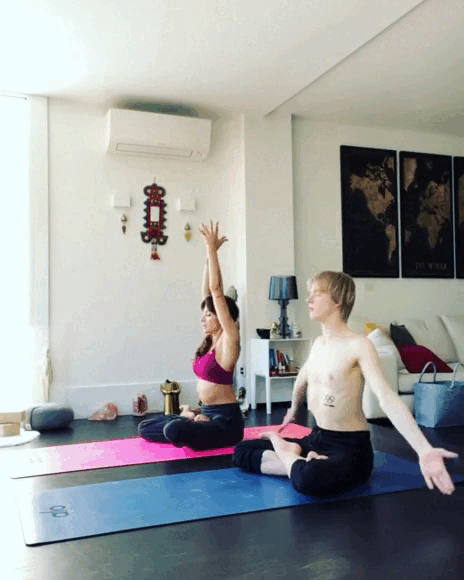
Do you go to the gym? And what about your favorite yoga?
I work very little in the gym at the moment, but I plan to make up for it at the end of the season. Yoga is also not going to work out – I have no time, because I’m at the rink all day. I always keep in touch with Nicoletta, but we haven’t linked up for online yoga yet.
But I started to work with the psychologist from Italy – just via Internet. I don’t know how I would have coped with all this without her help. I need to learn not to pay attention to what people say about me, to have more faith in myself and to trust my decisions. I want to be happy no matter what I hear from the outside. It’s my life and it’s up to me.
About getting moral support from Kamila Valieva 🙂
The European Championship was the most difficult tournament of my life. When I went to Finland, I was too dependent on other people’s opinions. Before the competition, for some reason I opened the broadcast on YouTube and was horrified to read how they wished me to fall, disrupt my jumps, and generally fail.
And then I returned to Moscow, and Kamila Valieva talked to me. She was very supportive, said she was worried about me because she had seen what I was writing on the Internet. And that I should learn to set aside negative comments – she knows exactly what she is talking about.
I’ve matured a lot in the last six months – as a figure skater and as a person. I’ve gotten smarter and definitely stronger. I’m looking forward to the next season – I’m ready for it.
What do you think about working with Daniil Gleichenhaus in terms of choreography?
We managed to change the track of steps in the free program, I really liked working with him. But I don’t know yet who will be choreographing my programs for next season; again, I’ll leave that up to Eteri.

Shoma Uno at one time tried to train at Crystal, but left rather quickly. Now do you understand why?
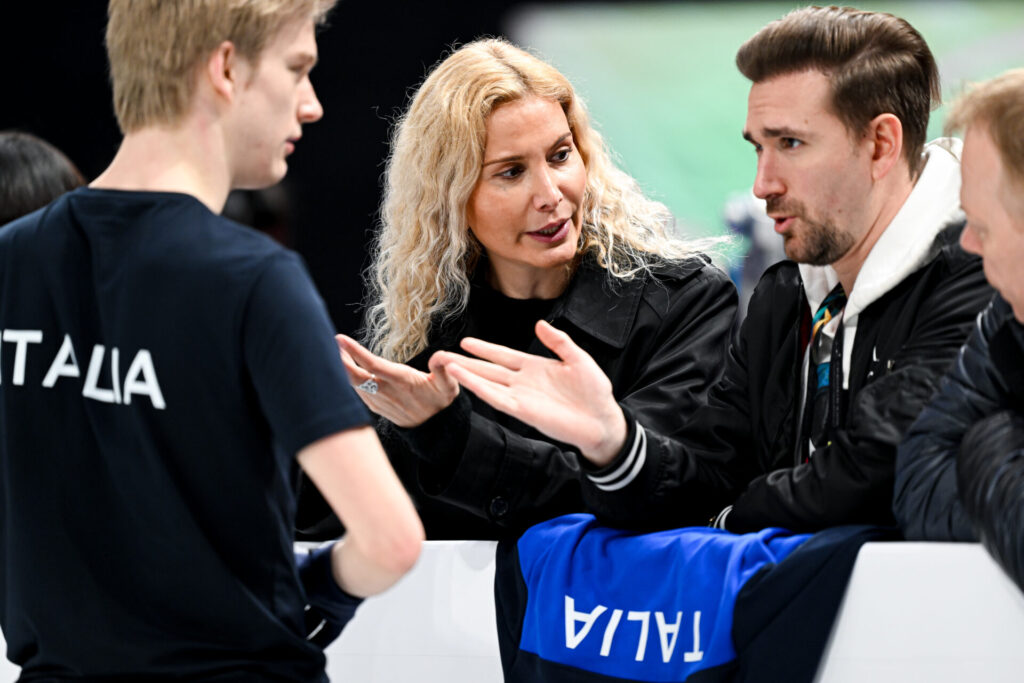
Yeah, I guess so. But I really like training to the limit and when the coach squeezes something out of you that you haven’t seen in yourself before. And Eteri knows how to push the boundaries of physical capabilities and bring athletes to the maximum result. Yes, it’s not easy to work under pressure all the time, but I’m steadily getting used to it.
You said it’s more difficult for you to perform if Tutberidze is standing at the boards. Why is that?
Well, she has so many top-notch skaters that I really don’t want to disappoint her. And I also feel responsibility: even though I have been working under her supervision for only a couple of months, everyone expects us to show magic results. I am filmed by cameras, my every step on the ice is examined under a magnifying glass – I want to meet these expectations.
You said it was easier for you to train in a highly competitive environment. There’s no problem with that at Crystal!
Oh yes! If someone jumps next to me for several quads in a row, it really piques my interest. It just really helps my motivation.
Here’s another thing: I’ve always liked watching women’s skating more than men’s. When I watch men’s competitions, I get nervous, I start to fight immediately, even in front of the screen. And I watch girls more calmly. In addition, the Russian girls are jumping at a completely male level of difficulty – that motivates me, too. It’s not for nothing that I always said I dreamed of training on the same ice as Anna Shcherbakova!
With which of the Kristalny athletes do you train together?
I’m in the same group with Sofia Akateva, Kamila Valieva, Morisi Kvitelashvili, Nika Egadze, Arseny Fedotov and Adelia Petrosian. I share the locker room with Nika, so that’s helping me settle in.
At training we communicate mostly in English, although the coaches sometimes ask me how a word is in Italian. And I already understand some Russian phrases – for example, the word “shit”, haha. Seriously, I trained with Angelina Turenko for a long time, so I’ve heard basic terms in Russian before.
Will you be taking part in Eteri’s show tour with the rest of the group?
No, we decided it would be better for me to focus on my training. Now I’m going back to Moscow for a while, then I’ll stop in Italy and fly back to Japan for the World Team Trophy (World Team Championships – Sports.ru). And then I’ll go to America for a month. In Boston I stayed with a wonderful family and I’ll be staying with them again. So I’ll spend my vacation there and travel a little bit, with New York and Miami as plans.
I’ve moved more places this year than I did in my whole life. I’ve never lived apart from my parents, and this season was a time of great change. In America I was alone; in Moscow we live in a small group, though each of us – myself, Maurice, and Nika – is busy doing our own thing and we respect each others boundaries.
Morisi Kvitelashvili admitted that the hardest thing about training abroad is getting used to being alone. How do you cope with it?
It’s certainly difficult. You miss home a lot, it’s still pretty lonely in Moscow – no close friends yet, so it’s not easy. I call Italian friends every evening, but of course, that’s not enough. Plus there is also the language barrier – that doesn’t help either.
Do you have plans to improve your Russian language skills?
I’m in the process! [Speaking Russian] “One bag, please”, “cash” – I go to the supermarket almost every night.
Do you have a favorite Russian food?
I really like your soups – especially borscht and cabbage soup. I always have lunch in the canteen at the rink, and cook dinner at home. I have tried dumplings, I can make pasta. But most of the time I buy something ready-made at the food store.
You haven’t made real Italian pasta for Moris and Nicky yet?
No, unfortunately. But I should – I have a couple of favorite family recipes.